Author: Frank Baker

  • Plus ça change, plus c’est the Scottish Football Association

    I returned to university after a gap year in France and I did as much as possible to fill my days with interesting things in the absence of sporadic conversations about the carrot crop in a foreign language. These thrills, I knew, would be hard to produce in a city I was much more familiar with (Stirling). So, I went on a quest for the sort of organisational trident that I thought would give my student life the order it required. I bought an academic diary and realised that academic diaries can have authors (Stella Cottrell). I found a Brambly Hedge themed calendar and took a liking to the drawings of the mice and its competitive price, so I bought that, too. Realising my poetry abilities, I nearly joined the Manchester University Poetry Society before realising that I was not a poet nor a student at the university of Manchester. It was a chaotic yet reassuring time.

    When I actually came back to Stirling, I quickly realised that Stella wouldn’t be the only one directing my student life (not the Belgian lager). Checking the weekend’s more obscure football fixtures became as important as checking my university schedule. Stella Cottrell herself would come to accept that her pièce d’oeuvre would be as much a place for collecting football related thoughts and visions as one for academia.

    My first game back up in Scotland was Stirling Albion (the Binos) against Clyde. A young Binos side conceded 4 and it was a pretty depressing state of affairs, but simply being there was enough. In Morrisons after the game and seeing fellow Binos understandably grimacing at the yoghurt section, I was at a loss for why I didn’t feel the same way. I was over the moon. Going to a fourth division match had given me the sense of organisation I craved in buying Stella’s diary, with the feeling of being alive that I probably wouldn’t have otherwise had to such a degree at 3pm on a chilly September afternoon. The football had taken over the diary. In the cheese aisle, I realised that it was the SFA that would direct my Saturday’s from now on, as was frankly always the case. It shouldn’t have surprised me.

    The next month, I was again in need of a footballing thrill, so took the Binos supporters coach down to Annan. A gaggle of expectant match goers straddled the pavement between Scotland’s biggest dedicated knitting clinic, the stupidly dark Morrisons pub and the vape store. Annan couldn’t possibly be more bizarre. Swapping the central belt for the flood plains of southern Scotland and meeting all of its eclectic characters was fascinating. We met the most racist lady in Annan who believed we should buy a house there for all the wrong reasons of which I prefer not to go into detail. In a charming greasy spoon with an unerringly sophisticated television menu system, I had a hot vimto and a pie. On that occasion, the Binos did alright for themselves, coming away with a point.

    Last Saturday, I was disappointed to realise that Stirling Albion’s home game with league leader’s East Kilbride was in fact not a home game at all. Fortunately, the Caledonian League (which in fact only covers about 20 square miles of Caledonia) saved the day with a local derby on offer at my very own university. Thrice finding myself at the wrong pitch, I eventually arrived twenty minutes past the 2pm kick off in a boggy field shadowed by Dumyat, king of the Ochil hills. Stirling based Riverside were the home team, playing Alva, a small town that grew through the textile industry just down the road.

    Riverside were the better team and came out 3-1 winners, but Alva provided the goal of the day with a 20 yard half volley which smacked the underside of the crossbar before pinballing into the loose hanging net. Another highlight was the senior referee arguing with Riverside’s terminally irritated super fan, whose bobble hat felt part of the act. The notion of junior football sides having personalised bobble hats is a development I posit that the founding fathers of Alva’s textile revolution could unlikely have predicted.

    I know that I could go to museums or to a café. I could alternate between the two of them every week. I could take up knitting and then go the scary dark pub beside it for a pint of stella. Hell, I could do nothing and probably feel alright about it. But I don’t, and I suppose one of the reasons for that is because I like doing things which I can at least trick myself into believing a whole lot of people care about, and that feels important. As I scribble the names of Caledonia League ties into my notebook, I imagine that at least one other person is doing the exact same thing, considering its frankly unsuitable name, checking the buses and on the bus picking out passengers who may also be attending the game. The other reason is that a game of football has the unique physics defying ability to last for hours, or minutes, or seconds, yet never 90 minutes, depending on its immeasurable volatility. Putting something so unstable, so effervescent into an upstanding citizen of a diary is like taking your lunatic pub friend for a scone. It is exciting and provides a sense of mischief without which the diary would cease to be of remote interest and likely retire to a cupboard of defunct bic rollerballs.

    So, I’ve got an idea. I imagine that at least one person reading this article (and I thank you for getting this far) either shares my view on the indispensable role football has to play on a Saturday afternoon or failing that has a broad philosophical view that Saturdays deserve meaning. The next time you go into a stationery shop, whether it be at a university or on the high street of a once blossoming textile town now filled with confusing shops such as “The Works”, find the academic diary section. Turn to a random future Saturday and write 3PM; that’s the first step. Then, load BBC Sport…

  • Misguided adventures in Flanders

    I was recently asked to write a piece about literally anything for a journalism class. I admit that this blog is turning into visitbelgium and I concede that I am powerless to do anything about it.

    First, I saw it on a map. Poperinge: it rolled off the tongue. I’d been in Hazebrouck for a couple of weeks at this point, and my confidence was ever improving. With a Gallic shrug, I resolved. Somehow, I would get to Poperinge.

    My small northern French village was well connected. I was only a brisk 10 minute walk away from the train station. From there, one could go to Paris but that wasn’t an option for me, since I wasn’t going to the train station. Outside was the bus stop. I had never seen the 61 departing and for that reason I didn’t believe it did.

    With its cartoon like headlights, the number 61 wouldn’t have looked out of place on CBeebies.  It possessed a certain elegance and as I walked on, I could almost feel its iron construction struggling to give me a nod and a wink.

    I asked the driver for a ticket to Poperinge. A greying man with a friendly face replied that it would be two euros and that I could pay only by card, on the scanner behind me.

    I noted that he didn’t pronounce it in the Gallic way I did; not with the guttural R one would usually associate with the French language, but a softer rolled version. His G was equally surprising; not soft, but harsh, an abrupt release of air that I don’t think either of us expected.

    We winded through the Flanders countryside and the vista was predictably wonderful. We rolled through seemingly empty villages and to keep myself company I imagined them coming to life on a Sunday afternoon. Without characters, I didn’t believe they existed. Like figurines on a model railway, I concluded they’d be added eventually.

    All of a sudden, the dress code turned grey and the roads and buildings were happy to oblige. All around were corrugated iron buildings which could’ve been industrial beehives, yet just as much entirely hollow polygons housing nothing.

    Shocked, I began to wonder what Poperinge was: a slight town with picturesque alleys, or an ambiguous sprawling jungle where I would struggle to find pleasure? I didn’t hold my breath when we finally entered the slight town I’d desired. We’d passed through many a pleasant village, none of which were my destination.

    I only shuffled out of my seat on the sound of the engine turning off; here I was, in Poperinge.

    I hadn’t questioned that I was in a picture postcard northern French town; that’s what everything was up here. Yet, inside the Spar shop I’d entered in search of a lunch time snack, not everything was as expected. The alcohol section was vast, which was far from unusual, but the garish colours of the bottles and cans was striking. A tower of red Jupiler cans stood ominously. The voices around me sounded foreign. Was the lager skyscraper affecting the room’s acoustics?

    At the checkout, I realised that they were speaking a language more like English than French. The realisation that they were speaking Flemish and that I was in Belgium hit me with a thrilling flood of realisation. On leaving the premises, I noticed what I hadn’t noticed before. In front of me was the Belgian flag.

    I took full advantage of my bizarre predicament and went in search of the sort of divine obscurities one finds on an accidental bus trip to Belgium. In a stationery shop, I purchased a Tin Tin ruler and made plans to return for the expensive staplers. The shop lady told me of all the places I should travel to and insisted on noting these recommendations on a nice piece of paper.

    Outside of the shop, I saw that a green space had been furnished with large photos of people on colourful backgrounds. The elections had been a few months earlier and the faces of the more moderate candidates were only just starting to fade. The harsher ends of the political spectrum had been, well, treated more harshly.

    Down the road, I found myself in a tiny bar which seemed only to serve Jupiler. I took a half pint and watched the Brugge game as two younger members of their fan club fought on the table beside me. I didn’t quite know where I was, and that was alright.

  • Tabacs

    It’s not like Stockport in Hazebrouck. There’s a market every week, the potatoes are dirty, you can go to the pub. And get a coffee. There are roundabouts, but not like at home; miniature, dye cast things with giants in the middle. The bricks are different and exist though the telegraph poles may, impose they do not.

    I lived in Hazebrouck as a language assistant for 9 months. On my final days there, I took a trip around my favourite places in an effort to capture them, capture the memories, the bizarre emotions felt towards otherwise average supermarkets and the illogic intrigue of foreign street furniture. A few days ago, I received the processed film from the photos I took that day, and realised that those photos would never be enough. The rush of feelings I felt living in a foreign country for the first time was complex, and viewing these photos is a stimulant now just as it was on arrival in Hazebrouck last October.

    My curiosity for the banal on European trips feels, in a way, peculiar. Hazebrouck is under 100 miles from Dover. Some would say that it’s not that different from your average Kent village. Why was everything so fascinating? Eventually, I realised that it was because I taught myself to be intrigued by things that aren’t really that intriguing: the paper on the menus, the way the weather is talked about, the perfection of the paving stones and the existence of a pavement at all. I’m sheepish to admit it, but I’m actually rather proud of that discovery. After all, none of the insights I’ll write below would exist without it. This isn’t meant to be a guide, or make sense in any sensible way. But, I do hope that you enjoy it. I will begin with the most important place.

    The tabacs

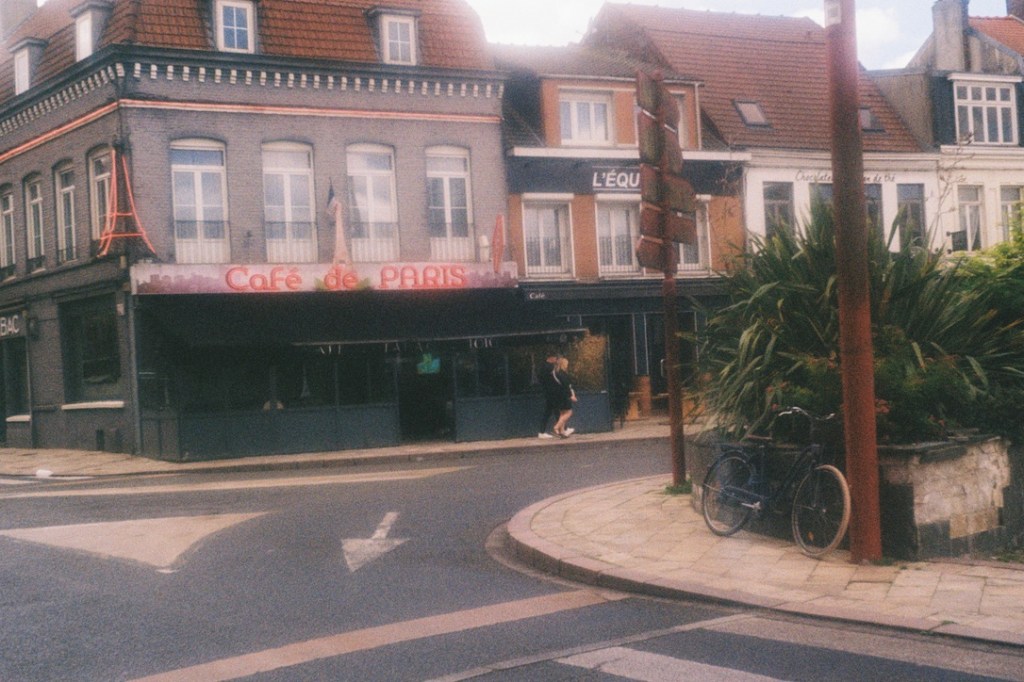
    The tabac is the place for controlled indulgement. It is in competion with la boulangerie for being the most essential part of a French town; while one can function without the other, it is much more desirable to have both. On offer are all the addictive pleasures a man can get; coffee, cigarettes, alcohol and gambling. Yet the tabac is far from a free for all. Though I couldn’t shake my habit of going to the bar of Café de Paris for the first few months, I eventually realised that this wasn’t the done thing. No, you sit down and wait; your destiny is in the hands of the waiter. Knowing this is strangely reassuring. Yet it is not always that simple; say you fancy a flutter. You may go to the bar, but you will invariably be ushered in the direction of the PMU terminal to the side. You may ask for a coffee as you place your bet, but make no mistake. Gambling won’t make the coffee arrive any quicker, for the bar is a complex operation, one of different universes which barely tolerate one another despite often being operated by the same person. Like the French state, it is designed to be resistant and unbreakable, not flexible to those who wish to bend the rules. To outsiders it may even look silly, but that is part of its charm.

    Gambling in the tabac is better than gambling anywhere else. Betting slips are available but the more common choice among todays gallic youth is to utilise the nifty Parisports app, instead taking a QR code up to the bar to be scanned. Once, I left my phone under the scanner as the barman conversed with a regular; he was rather bemused when he turned back to the screen, before him on the screen 500 identical accumulators. Hundreds, possibly thousands of euros worth of bizarrely assembled accumulators; had this man really such faith in his knowledge of the English Championship? Don’t leave the phone under the scanner for any longer than necessary, I would learn. I was told this on multiple occasions, but the gallic charm was never insistant, not in that way. “Ca arrive”, he would say (“it happens”). The bit about it really only happening to me was unsaid. I learnt eventually.

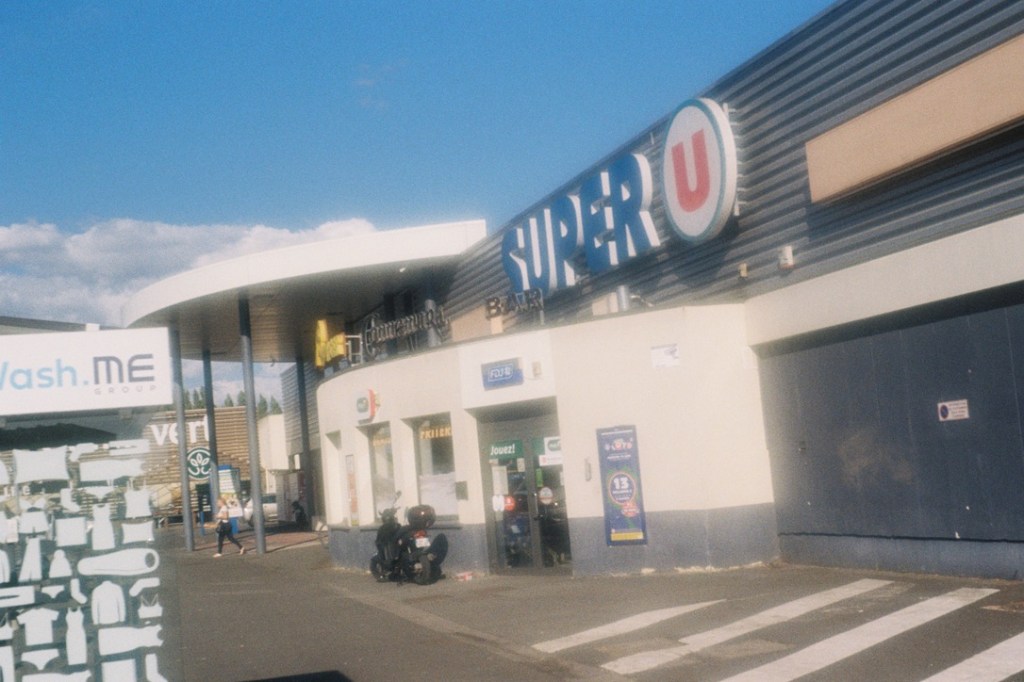
    A month into my time in Hazebrouck, I was doing my drying in the big tumble driers outside Super U (a supermarket), dipping into a huge bag of frites as they completed the final spin cycle (the clothes). Familiar with the unreliable nature of the Super U spinners, I was happy to be relieved from my bored snacking by the arrival of the owners and employees of the Super U tabac, having just closed up. “Ca va monsieur”, said a man in his early 30s. I explained that I was from Manchester, and a conversation about football inevitably ensued. Despite my still limited conversation durability and his extremely strong northern French twang, we muddled through. His mate, who didn’t work at the tabac, spawned in and began telling me about his ten fold accumulator, which appeared even more eclectic than the sorts I’d been placing at Cafe de Paris. The woman behind them, who I later found out was one of the owners, was as interested and jolly. Yet it was the betting man that convinced me. In a joyful cultural haze, I’d put all my eggs in one tabac sized basket. But as the winter months arrived in Hazebrouck, Cafe de Paris had a competitor.

    My first visit to le Connemara took place only a couple of days later, post big shop. As usual, I took the cafe allonge. Sticking out like a saw thumb at the end of the checkouts (imagine the Wetherspoons in a plush new airport terminal), le Connemara gave off this curious warmth. I think part of its cosiness came from its isolation; it was a bar exiled from the outside world. Despite its location within the bowels of one of France’s largest chain supermarkets, the majority of its customers, unlike me, hadn’t come in as an afterthought at the end of the big shop. And the lack of engagement from Super U workers indicated, at the very least, that this wasn’t a Morissons cafe concern. Though there was an outside door, opening out to the giant tumble driers, and from there wider society, it was only when the regulars made their exits that the outside door’s hinges were made to do any work. As I was sipping away at my cafe allonge and examining far too intentionally the ingredients of the day’s shopping, I realised that I was slowly but surely blending in to le Connemara and starting to fall for its optician size televisions and mysterious customers. When another regular would walk in, or just someone who looked like they could be, everyone would turn and say “bonjour”. By the third visit, I was getting the same treatment, sometimes along with a handshake. I began to bet on the horses on the corner tele, and my flatmate Allison, with her equine wisdom, would give me betting tips. In one of our final visits to the supermarket tabac (although, I acknowledge that this monica belies the true beauty of the place), the white wine sipping gentleman beside us enquired as to what an earth two anglophones were doing in a town like Hazebrouck. He revealed that he had himself immigrated from Argentina as a child, and although his criticism of the french working mindset and the benefits system urked my lefty brain, I didn’t really care because there was no doubt; I was in the connemara cast.

    I imagine that on my eventual return to France, I very well might have to start again as a tabac novice, and that the only way to return to my spring 2025 glory would be to go through the whole process again. Yet, I am honestly rather content with having achieved moderate tabac respectability just the once. Inevitably, I’ll try again on my study period, comforted by the knowledge that underdogs can work their way into the seemingly immovable anthropic furniture of the tabac. And, if I don’t succceed this time? Well, le connemara will outlast us all.

    My intention is to publish a couple more niche observational pieces on my time in Hazebrouck. If you fancy a bit of that, I think you can sign up for email alerts at the bottom of this page. In any case, cheers for getting this far!

  • Scores on the board, divided by two.

    I was in Brussels visiting the European Parliament.  In a very French way, the clocks of Belgium chimed 11 and, of course, the group I was with decided it was lunchtime. I had an Americaine frikadelle, which is a sausage possibly containing chicken, lodged in a baguette, topped with a little too many fries and a sauce whose flavour loosely corresponds to its given name. After probably doing something wrong with the identity crisis sausage, I dipped into the corner shop for a refreshing Lipton. The man was friendly, but a Lipton, he claimed, would not be enough for card payment. “Would a Bounty”, I asked, and the answer was no. Alas, I had no choice but to turn my eyes over to the journalism section. “DH Sports”, I muttered, as much a question to myself as to the man, and, before DH Sports had made its response, with a scent of cardboard mustard and a promise of Jupiler League wisdom, I was out of the shop and back on the streets of waffle town. 

    A few hours later, on the mini bus home, I was shattered. And the front page of DH sports was no more reassuring than the future of Europe I had been told about earlier that afternoon. I searched for stimulation in the form of Belgian sports headlines, each and every one of them daunting, and the cardboard mustard scent acted no longer as a pheromone, but as a poison. The football headlines made sense, and yet the numbers to accompany them seemed inexplicable, the tables disorientating. Separated by big, bold titles, were three divisions. As somebody who’d made an effort to understand the Scottish Split, this should’ve been easy, yet in every nook and cranny of this bemusing diagram was a question to which I had no response. 

    Union SG, were at the top of the CHAMPIONS PO league on a bizarrely low figure: 47 points. Liverpool, who’d just won the Premier League back home, were on 82. Either this was the most competitive league in the world, or perhaps Belgium had an absurdly lengthy winter break which I was unaware of. I’d watched a fair few war films, and Belgium was definitely cold. In the first position of the EUROPE PO, Charleroi sat in a European conference league playoff spot, yet so did Anderlecht, and they were 4th place in the CHAMPIONS PO group. Antwerp and Gent also looked to be missing out on Europe, despite both fairing better than Charleroi, occupying the final two places of the Championship group. Meanwhile, in the RELEGATION PO, who knew what the feck was going on? Barring last placed Beerschot (which is exactly what I could’ve done with), every club had more points than the apparently superior EUROPE PO group. 

    Crossing into France in my nauseous sports paper delirium, I made the choice that the only way to resolve matters would be, as is often the case, to write, and it was at that moment that CoupFrank’s May post was decided. Welcome on board. 

    In 2009, little to British Prime Minister Gordon Brown’s knowledge (I imagine), the first division of Belgian professional football underwent a radical change. That’s right; they introduced playoffs. After everyone’s played everyone twice, the league’s split into two. The Championship group includes the top 6 teams. Before the split, all of their points are halved. Of course, this leads to some clubs being on, as an example, thirty two and a half points. That’s why points are rounded to the nearest integer if this is the case. They’re not soft, the Belgian FA. Everyone in the championship PO plays everyone else in the Championship PO twice, before we get to see the final standings. The top three qualify for Europe, while fourth place enter a playoff for the privilege (more on that later). 

    Now for the second bit of split, the Europe PO. The teams who finished 7th to 14th in the regular season compete for a place in the second qualifying round of the Europa Conference League, but, again, only after having their points halved and then made back into whole numbers. Naturally, you’d think that this means first place get second qualifying round Conference league football, but it’s not easy being the seventh best Belgian team. They’re put to the test one final time, against the 4th placed team in the championship PO.

    By the time we get down to the third bit of split (aka 13th to 16th placed, before the split), it seems the Belgian FA’s calculator has run out, as no halving of points takes place. After every team places every other team twice, it’s only the top team who are safe. Second placed must fight a relegation playoff against the winner of the challenger league/second division playoffs (which are comfortingly normal and unconvoluted). Finally, as you’ve probably predicted, third and fourth place are relegated. Unfortunately, that was the fate for my adopted Belgian team, Kortrijk, who sit just over the Franco Belge border. If only they’d waited until next season, they’d have stayed up, with the league moving to a pretty average 18 team league from 2026/27.

    Yes, that’s right. The DH sports malaise and the subsequent knowledge obtained was worth it, for one more season. I hope you all enjoyed getting split fit anyway. I certainly did. It’s just a pity it was, arguably, time not that well spent. Maybe there’s something to be learnt from this. Or perhaps, you’ll take what you can and immerse yourself in the Jupiler Pro League run in, where two points separate the top two with a couple matchdays left. I know what I’ll be doing. Anyone for a bounty?

  • Sam Fender and all the Geordies in Belgium

    I think I rather like the idea of running away.  Not in the sense of running away from anything in particular, since my small French provincial town would doubtless struggle in any sort of impassioned chase, but running towards something. A century ago, that something would have been a quayside, a tourist information building filled to the rafters with sundry train and bus timetables, lost and misguided young men feverishly exploring their contents in search of an undefinable aspiration. Today, however, running away is far easier.

    It was just gone two in the afternoon and the language assistance correspondence was seemingly never ending, one part down to my slow French typing speed and another part down to a rogue index finger. This rogue index finger which could not be stopped from manipulating the trackpad on its whims; emails, the BBC homepage, emails again, the French news! This rogue index finger was my very own lost vagabond, quivering at the sight of the various tabs of British telecommunications mail; indésirables, boîte de reception, fubar nightclub over 30s night, B&Q, shoes (in your basket, did you forget something?) etc’ etc’. 

    Within good time, however, this rogue index finger had found something far more valuable; Sam Fender at Forest National Brussels: tickets available. It turned out that amongst the pile of deceivingly personally addressed invites to lowland small town Scottish nightclubs and DIY mega store sales, was something far more appealing, far more tangible. It was barely believable; signing up to a waiting list for a sold out gig is a fool’s game. I had imagined the employees of Forest National gathered around an iMac monitor in their plush offices, reading out the names on this waiting list over a few bottles of Leffe. They would eventually get to Frank Baker, and, in a very Dutch way, would mischievously, joyfully cackle, and the intern would get out his pointy stick and gesture it in the direction of the A3 chart on the wall of a very obviously sold out Forest National arena. Yet, none of this had happened and I was off to watch Sam Fender in Brussels. There would be no ships involved, no ambiguous farewells to the village folk. This was running away in the modern era. 

    What felt like only a matter of hours later, I found myself navigating the station quarter of Brussels, which itself seemed to be experiencing the sort of identity crisis mulled over in Sam Fender’s music. The gigantesque Brussels Midi tower stood awkwardly in this confused little segment of the capital, a darts player in a suit and tie, a sausage in a tiramisu. Etc. Where, in this confused little segment, would one find a hostel? 

    Your Hostel, as in my hostel for the night, was just around the corner, which meant circling a good few roundabouts, but I was in Belgium so that felt oddly comforting. The man on reception, who seemed to be one of about two people who ran the place, had me make my payment for the bed, and then asked me to take a seat on the shabby couch just behind. It seemed he was getting a group of us together: the 5PM check in gang. So off we all went to our very grand and very large dorm (30 beds in all). In terms of hostel pals, the American couple had selected the geeky Frenchman with round glasses, and he’d obliged, in the subtle French way that French men tend to oblige. My remaining options all seemed to be lost souls with perplexed looks on their faces, as if searching for something their exceedingly large duck taped suitcases didn’t contain. Alas, I decided it was time to make my move. I would be back, but I had a meeting with a Geordie.

    After a heartful Moroccan meal, probably cheaper for my choice of sitting in the single occupancy terrace, with breathtaking views into the windows of the Midi tower, I took the tram up to Forest National. Unlike most similarly named establishments, which tend to take their name from the apparently beautiful really wild thing they replaced (take any English housing estate as an example), Forest National was undeceiving in its title. From my wooded viewpoint, I observed the Brussels suburbs as they dozed off into the evening. Adolescent cyclists tackled speed bumps with the tact of a land rover. Bees floated around in a manner that seemed Belgian but was perhaps mere placebo. It was going to be a good night.

    Inside, it was hard not to notice the dress code, strictly monotone. Some Belgians, and possibly a handful of French were scattered in among the Geordies. The Magpies, who of course had won their first domestic trophy in 70 years only three days prior, were jovial, but not ecstatic. No, it was a feeling of mutual content inside Forest National. Snippets of conversation with fellow NUFC clad travellers would take place as the night went on, but almost in hushed tones. The audacity of beating Liverpool in a cup final, of being in Brussels three days later, Jupiler in hand, CMAT about to take to the stage, was outrageous. The barman, who worked for free in return for gig tickets, had no idea who Sam Fender was and as far as he was concerned, Newcastle United would only be relevant if I could name a Belgian player to have graced the St James turf. I could’ve said Philippe Albert, but a mix of modesty and joyful amnesia made that impossible. Of course, we were all immensely proud, inebriated by life, but that was our secret. We all knew. 

    CMAT took to the stage and was tremendous, as always. In all honesty I can’t remember, even after consulting the streaming services, her setlist in the sort of minute details which would make commenting on it worthwhile, and concocting praise for the sake of it would do her an injustice. Regardless, give her a listen.

    A half an hour pause followed, and on came wor Sam to a jubilant rendition of Going Home. I’d like to imagine that the avian inhabitants of the nearby woodlands succumbed to Mark Knopfler’s genius in the manner of a sort of Geordie pied piper, but that’s something for Belgian spring watch to contend with. In any case, it cannot be understated how impressive a piece of work Sam’s new album is. Every track in there is blessed, or cursed with the ability to make you smile, laugh cry. And after listening to the album in full, you listen to the lyrics, and every line is considered. It is prose more than worth its melodic charm. Nostalgia’s Lie, Reign Me In, Little Bit Closer are all memorable from an album point of view. Yet it was TV Dinner and Something Heavy which stood out in Belgium. Just the lyrics of TV Dinner are deserving of some sort of reward, maybe a Carabao energy drink or something. We do all love Carabao now, after all. 

    I must’ve been one of the last to leave, taking it all in, as if in the away section of a European football match, locked in on Police orders, fascist hooligans outside the turnstiles. But there’d be no fascist hooligans, only friendly Belgians, as I walked the 90 minutes back to the centre of Brussels. At one point I came along a few Irish lads, all in black and white, equally as lost and stunned as I outside a huge Audi factory. As the clocks ticked slowly towards midnight, as trams surged into the capital’s suburbs behind us, our odd group had become an anomaly among the Muslims celebrating their Ramadan evening meal. Memories of that hallowed Sunday afternoon were eagerly bounced back and forth between us, vivid descriptions of Dan Burn heading in our first, Alex Isak volleying in our second, our journeys to Brussels and whether, standing outside this Audi mega factory, we were even still in Brussels. Talk of Sam Fender, People Watching, CMAT would inevitably come up at some point, but it hardly felt necessary. Because of this precise moment, everything was going to be alright.