
A few weeks ago, I went back to Lens. I’d made Racing Club de Lens my club of choice when I lived in Hazebrouck last year and whether they were home or away would often determine the mood of the weekend, along with the amount of money in my account. On returning to France, this time to the less quirky Loire valley, I knew that at some point I would have to again set foot in the Stade Bollaert Delelis, yet the majority of the season had passed and I still hadn’t. Perhaps that was because I knew that re-entering a past life already closed is usually unwise. However, I would soon be heading back to England, and that would prevent any unhelpful comparisons born of nostalgia being made between Angers SCO and Lens, so it was the right time to go back. In any case, this time I’d be writing about it, and a sense of needing to do the club justice on paper fuelled my decision as much as an eagerness to return to a place full of happy memories.
In an effort to comfort myself over what I’d paid for a ticket on Lens’s resale platform, I opted for the car sharing site, BlaBla Car over the train. Unsurprisingly, as a consequence I would still have to catch a train and a bus to a little town in the Loire valley called “La Flèche” in order to meet my driver: a two hour journey. There, I nipped into Carrefour for a large bottle of sparkling Perrier and as I enjoyed a café allongé my driver alerted me of her early arrival. The conversation shifted pleasantly from observations of the local landscape, the weather and the traffic towards the more meaningful. We discussed golf, a sport for which she was training to be a referee and shuffled cautiously onto the subject of her line of work. Our second passenger was a social care worker so we discussed the injustices of their pay and got as far into politics as wind farms. Our driver was somewhat of a climate change denier so I stuck to safer ground, like the under-appreciated charm of the newspaper. We agreed especially on La Voix du Nord, which we both considered an excellent source for local and global affairs. Eventually, we returned back to golf. The conversation had begun to stutter 50 miles or so south of our destination; our arrival in the large town of Arras was timely.
On the regional TER service to Lens, I imagined that the purple seats were the same as those I’d sat on through win, loss and goalless draw and that the 50 or so supporters on board with me were in fact the entire fanbase. From football one can genuinely believe that society is as simplistic as the goings on in In the Night Garden or the Telletubbies. Perhaps, that is why others seek comfort in 10 part blockbuster dramas on Netflix, but as football fans we don’t merely watch others in the midst of their uncomplicated lives, bitterly envious of imaginary worlds that don’t exist, because we have created miniature worlds which are indeed simplistic enough to satisfy this craving for a world that is genuinely readable. I hadn’t been here for a year, but I was already written into the final credits.
At the beautiful art décor style station, I attempted to figure out a route to C’s but gave up and turned to my phone. Of course, I could’ve asked any of my 50 fellow supporters and they’d have known the answer. I ought to have done so, really. I had found C on my vaporised bed and breakfast site of choice last year once I realised that French trains finish before last orders and her hospitality was generous and real, as it tends to be in the region. After a few minutes she asked if I’d “brought l’apero”, which I hadn’t, so she directed me to the “Arabe du coin” where I would be able to source a contribution. She told me not to call it so at the corner shop, an instruction I heeded. I gathered that it still wasn’t as offensive as the obvious British English pejorative for convenience store. Unbelievably, what we would call “pres”, that is a few drinks before the evening’s outing, have in France come to be known among certain groups as “le before”. The “before” comprised of toasted bread with sautéed mushrooms in between and a few crisps. Half way through the pre-match preparations my fellow guest turned up, a Nantes fan. Nantes, Lens’s opponents for the night, had to all intents and purposes already been relegated, and this Nanteois had decided to begin the evening as modestly as possible by consuming for his tea only a large box of grated carrots. It could only get better from then on in. For my part I decided to inflate expectations by consuming some 8% proof local lager.
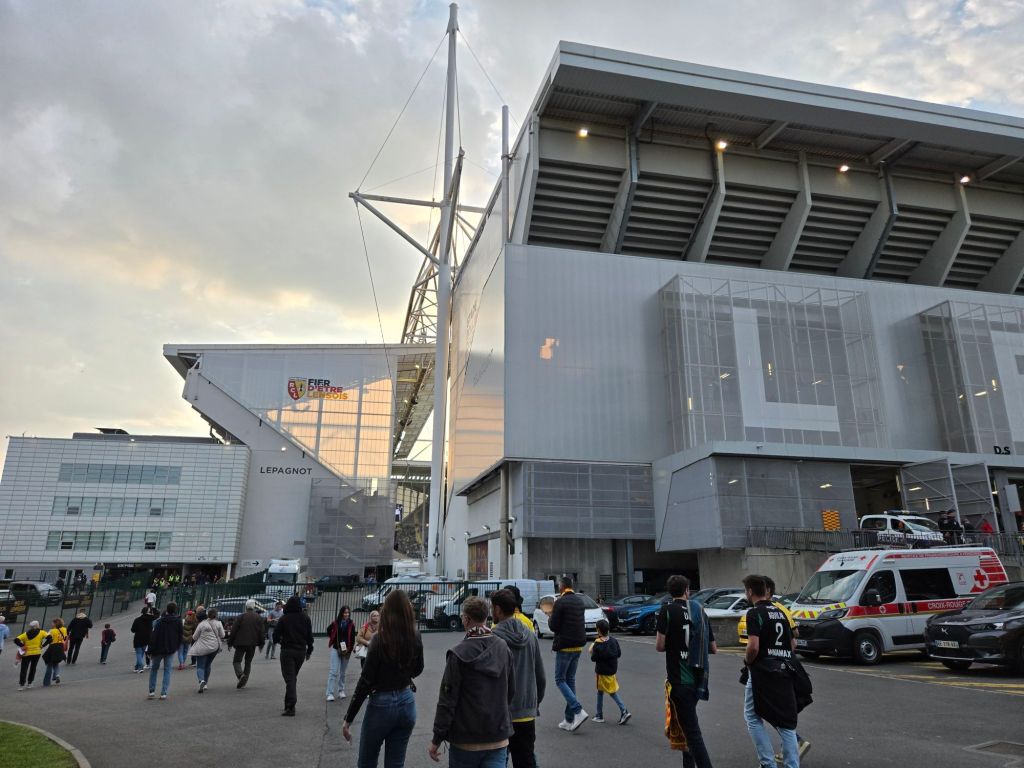
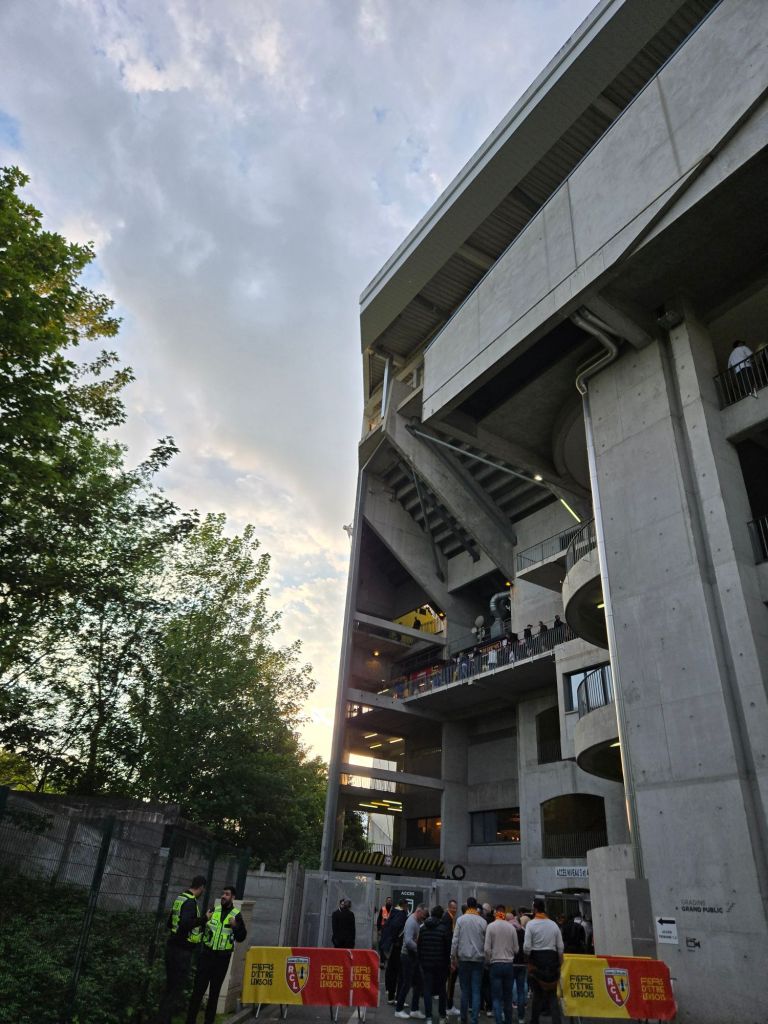
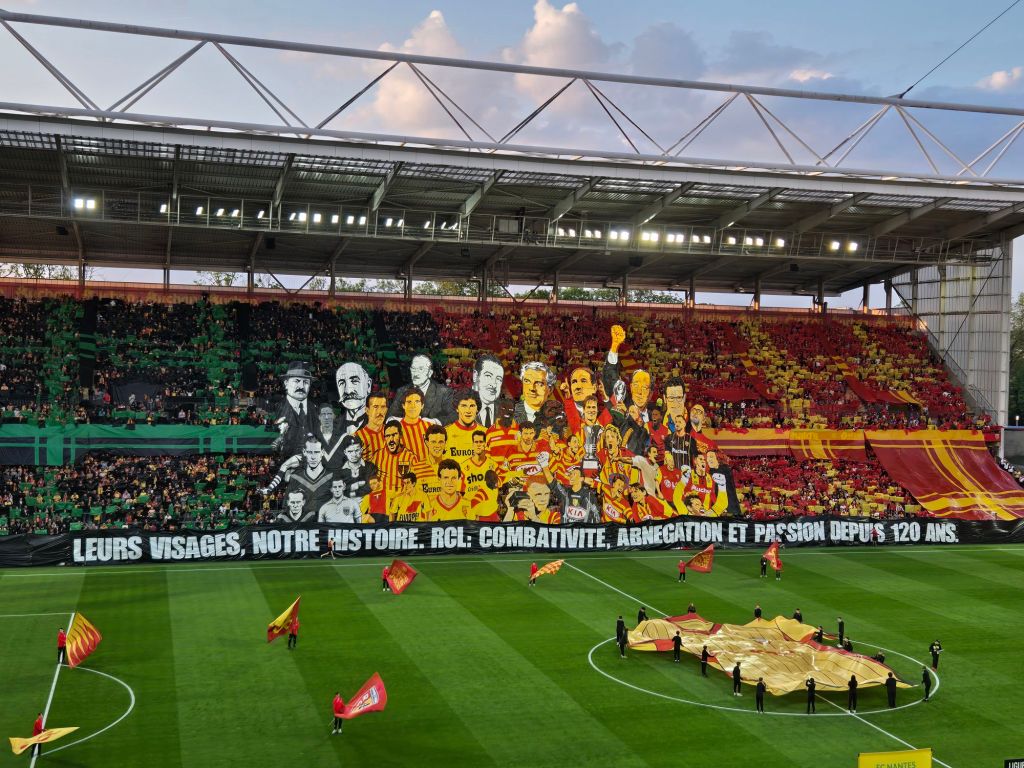
This Nanteois was in fact born in Germany. I tried a little German but it was easier, for me at least, to tackle the subject of Nantes’s miserable season and imminent relegation. We also talked of better times, them winning the Coupe de France for example. Lens themselves would be playing in the Coupe de France final three weeks later, searching for their first ever cup win, so we logically talked of that too. We went our separate ways at the turnstiles, him to “le parcage” and me to the upper reaches of the Lepagnot on the side of the pitch. A tifo of Lens legends through the years was dropped from the stand opposite me, featuring Monsieur Bollaert himself, who as president of the town’s thriving coal mines took the decision to build the stadium in 1931. Félix Bollaert was passionate about improving the lives of those who worked in the town’s expansive coal mines; him and his wife founded a charity which distributed food to new borns whose parents worked in the industry. The coal mining heritage has quite literally shaped the place; as you walk alongide Le Stade Bollaert you notice the huge slag heaps, “les terrilles” which dwarf the unimposing vegetable fields 600 feet below. The last mines closed in 1991, but over 100 years of coal exploitation irreversibly shaped the area.
Lens supporters seem to be proud of what built the town and their club, but not out of blind nostalgia. They’re well aware that Europe’s greatest ever mining disaster took place 7 miles out of Lens and left 1500 dead. It seems that they celebrate their history not because they want to go back in time, but because that history is an inevitable and irreversible truth, and thus they might as well sing and dance in homage to it. It’s an acknowledgement of the curious way by which the chance discovery of a precious earth property led half a million Poles to work in France’s mining industry after the first world war and that many of their ancestors continue that eccentric story in watching their beloved RCL. It’s rather confusing and yet it isn’t at all. In fact, it’s rather beautiful.
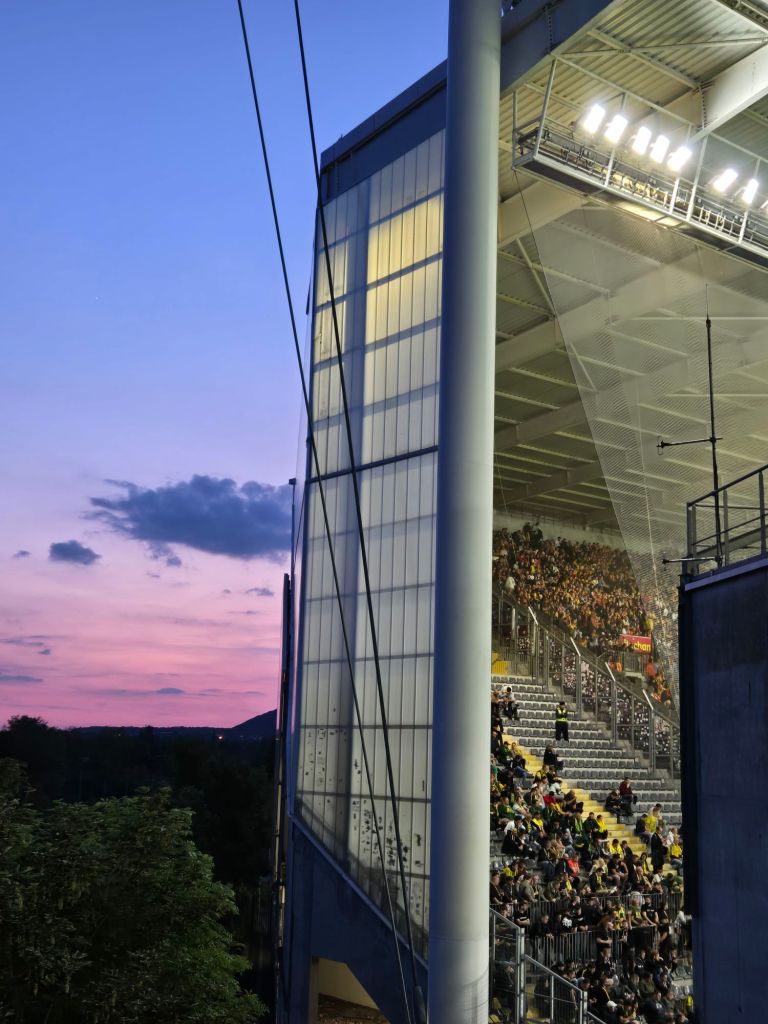
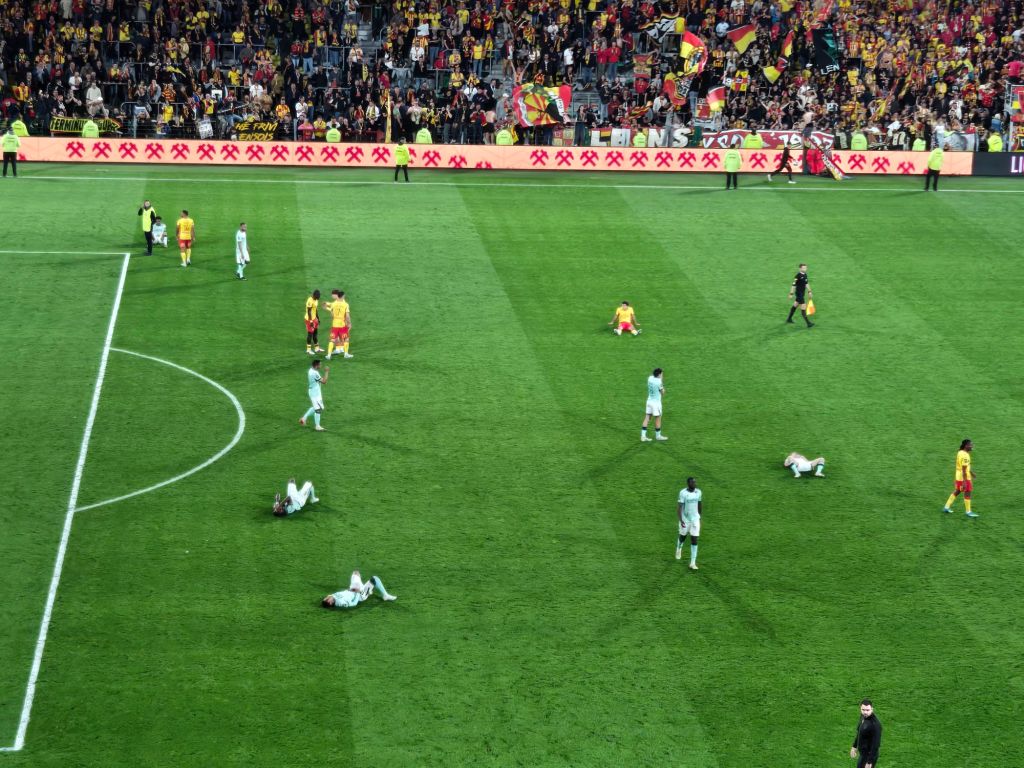
The tifo was slowly withdrawn to reveal the scale of the nervous bounciness on the terrace the length of the pitch it had covered. Lens predictably started with intention and energy; their first chance fell on the eighth minute. Yet, by the half hour mark the home side had taken the foot off the throttle, the too audible horn of the 8.58 train to Dunkirk passing behind the Marek kop evidence of a nervous Bollaert. Later, left winger Saïd was in on goal but his shot was well saved by the Nantes keeper. Chances continued to fall for Lens but they couldn’t get the goal they needed and at half time the score was 0-0. You couldn’t rule out Nantes either, who despite almost inevitable relegation had created a few chances themselves. They would leap at any opportunity to ruin the occasion.
Lens put the ball in the net twice in three minutes with around twenty to go, but both were ruled offside by the ever-detestable VAR control room. Again, you began to wonder whether it was Lens’s day. In the 78th, Lens made two substitutions, handing 16 year old Mezian Soares his debut. A minute later, Soares was soaring towards the kop, a childhood dream fulfilled in the form of a hard strike into the bottom right corner. The 16 year old had sent Lens into the Champions League within a minute of his professional debut and he celebrated with the pure crazed joy of a man who wanted to relish every second of a moment he couldn’t quite believe was real life.
It finished 1-0 to les sang et or. I left 20 minutes into the end of season presentation, which featured a light and fireworks display. The Irish bar down the road felt more appropriate and that’s where I headed. There, I got sat down in an impossibly large circular booth and stuck to the Cola, which didn’t go unnoticed by my booth mates who promptly began to boo and attempted hypnosis with a pint of local lager floated soothingly in front of my sober eyes by a hand of 50% alcohol content. It had been too long since I’d been at the Bollaert, and I wanted to remember the experience in all its raw brilliance the next day, so I politely declined the offer. Our Nantes friend was there, happier with a pint than a box of carrots in spite of his club’s relegation. At least it was all over, he said. So, we talked chaotically until two in the morning. A fellow called Max wanted to visit Scotland, so I described it to him and told him to take in some football on his travels, and an Italian called Stefano gave us an improvised rap performance which began unexpectedly well and finished rather disappointingly grotesque. The beer is a huge part of the culture, but not in a way that seems too unhealthy. The culture seems far more insouciant and jovial no matter the result and I have very rarely seen the excessive drinking descend into violence as you too often see over the channel. Terrible dancing was all the rage. It is not the image we have of France and perhaps that is because Lens is so close to the Belgian border. I also observed a parity of gender greater than that in the UK which was refreshing, and a bonhomie between strangers which I think society desperately needs and without which football loses its soul. Then there’s the price. For club members, going to watch your team is more affordable than it is if you support an equivalent sized EPL side. Sure, there’s cultural stuff going on, but I imagine that a lot of it boils down to money.
The next morning, we visited the Louvre Lens, an impressive contemporary glass building constructed on the site of an old mine just down the road from the Bollaert. Inside, you’d be shocked not to see at least a few museum goers sporting the red and yellow of Lens. In doing so they remind the marble statues of Greek gods who the land really belongs to. I boarded my train to Paris and decided that I’d be back before too long. You don’t have to be a Lens fan to value its contribution to the footballing world. Like many of the most famous football cities, it’s a gift from the footballing Gods far greater than anything Venus ever contributed, but I wouldn’t say that too loudly in the Louvre.


Leave a Reply